



REVIEW
Technology Talks
Austria 2026
Save the Date #TEC27
9–10 September 2027
כותרת: ספירה לאחור
00
days
00
hours
00
min
00
sec
TEC26 in review
Highlights and impressions
from 10-11 September 2026
at the MuseumsQuartier Vienna
Under the 'Empowering Europe: Technological Leadership for a Resilient Future' Technology Talks Austria 2026 brought together renowned experts, visionary thinkers, innovative researchers, and committed politicians and industry representatives. Together, they discussed the central importance of research, innovation, and technology in increasing the competitiveness of Austria and Europe.
30 hours of top-class programming featuring a total of 140 speakers: 2 incisive keynote speeches, 6 diverse plenary debates with 30 plenary speakers from 12 countries, as well as 12 in-depth workshops and 5 special events featuring a further 110 speakers. On top of that, there were numerous discussions at our exhibitors’ stands and, of course, at the get-together!
Details of the 2026 programme and speakers can be found here.
Take a look back at #TEC26 and look forward to the
Technology Talks Austria 2027, which are scheduled for 9 and 10 September 2027 at the MuseumsQuartier in Vienna!

© Katharina Schiffl
Top-class speakers
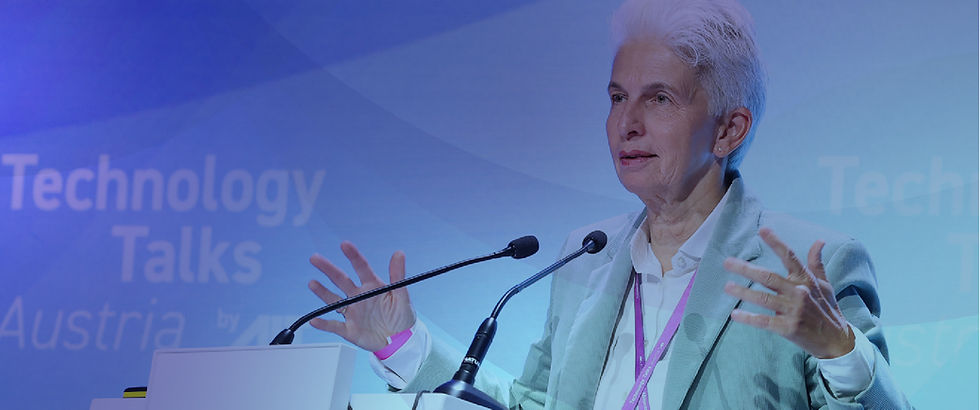
Among those taking part in the on-stage discussion were Christian Ehler (European Parliament), Jo De Boeck (imec), Marie-Agnes Strack-Zimmermann (European Parliament), Dominique Foray (EPFL Lausanne), Sabine Herlitschka (Infineon/IV), Lars Reger (NXP Semiconductors) and Natalie Guichard (EDA) discussed resilient infrastructure, innovation ecosystems, industrial leadership, dual-use technologies and technological sovereignty.
Driving the innovation ecosystem forward
Here are some key messages from the wide-ranging and in-depth discussions:
-
Turning research and innovation potential into lasting strength:
Europe boasts excellent research, innovative start-ups and a strong industrial base. It is crucial to develop these into globally successful companies and industrial value creation, whilst at the same time securing technological leadership through long-term capacity-building, high-performance research infrastructures and critical mass.
-
Greater speed:
In the global technology race, speed is increasingly becoming a decisive competitive factor. Europe must speed up decision-making and approval processes, mobilise investment more quickly and scale up successful technologies more rapidly.
-
Focusing on Europe’s strengths:
Europe does not need to be a leader in every technology, but should build critical mass and establish international leadership in those areas where scientific excellence, industrial strength and strategic relevance converge.
-
Building resilience from the outset:
Critical infrastructure and technological systems must be designed to be robust, adaptable and secure from the outset; this also includes diversified supply chains and reliable access to critical technologies.
-
Bringing research and industry closer together:
Scientific excellence must be translated more quickly into technological and economic impact – through seamless transfer pathways between universities, non-university research organisations, start-ups and industry, as well as through better opportunities for demonstration, testing and scaling up.
-
Mobilising more growth capital:
A deeper and more integrated European capital market, more private growth capital and attractive exit opportunities are crucial to enabling innovative companies in Europe to scale up.
-
Thinking of Europe as a single market:
Technology companies need a European home market in which they can scale up rapidly. To achieve this, national fragmentation and regulatory barriers must be reduced, and strategic investment must be coordinated more closely at European level.
-
Securing access to critical resources:
Technological sovereignty requires reliable access to critical raw materials, energy and intermediate goods. Europe must reduce one-sided dependencies, promote the circular economy and substitution, and make its supply chains more resilient through diversified international partnerships.
-
Taking dual-use potential into account strategically:
Many key technologies are relevant to both civilian and security and defence applications. These interrelationships should be taken into account at an early stage, and security – in the sense of ‘security by design’ – should be factored in from the outset.
-
Strengthening technological sovereignty:
Technological sovereignty does not mean self-sufficiency, but rather Europe’s ability to make independent decisions and take action regarding critical technologies, and to possess the necessary expertise and capacity to do so – whilst remaining open to trustworthy international partnerships.


The Technology Talks Austria
for review
Our highlight video
Highlights of the two conference days and a review of TEC26.
Our partners
Whether as sponsors, exhibitors, or speakers on our stage: For years we have been connecting globally successful technology experts with researchers, industry representatives and the best minds of tomorrow.
Organizer

Main Partners


Event Partners


Scientific Partners


Workshop Partners





Venue Partners


Media Partners


Additional Partners





© Valerie Maltseva
Technology Talks Austria

DI.in Dr.in Brigitte Bach, MSC
Chairwoman Board
Managing Director AIT

Univ.-Prof. DI Dr. Andreas Kugi
Chair Scientific Advisory Board
Scientific Director AIT
Your contact person


Save the Date!
9–10 September 2027
Save the Date!
9–10 September 2027
Save the Date!
9–10 September 2027